Position: AI Is Not Ready for Strategic Conflicts
Publication
Position: AI Is Not Ready for Strategic Conflicts
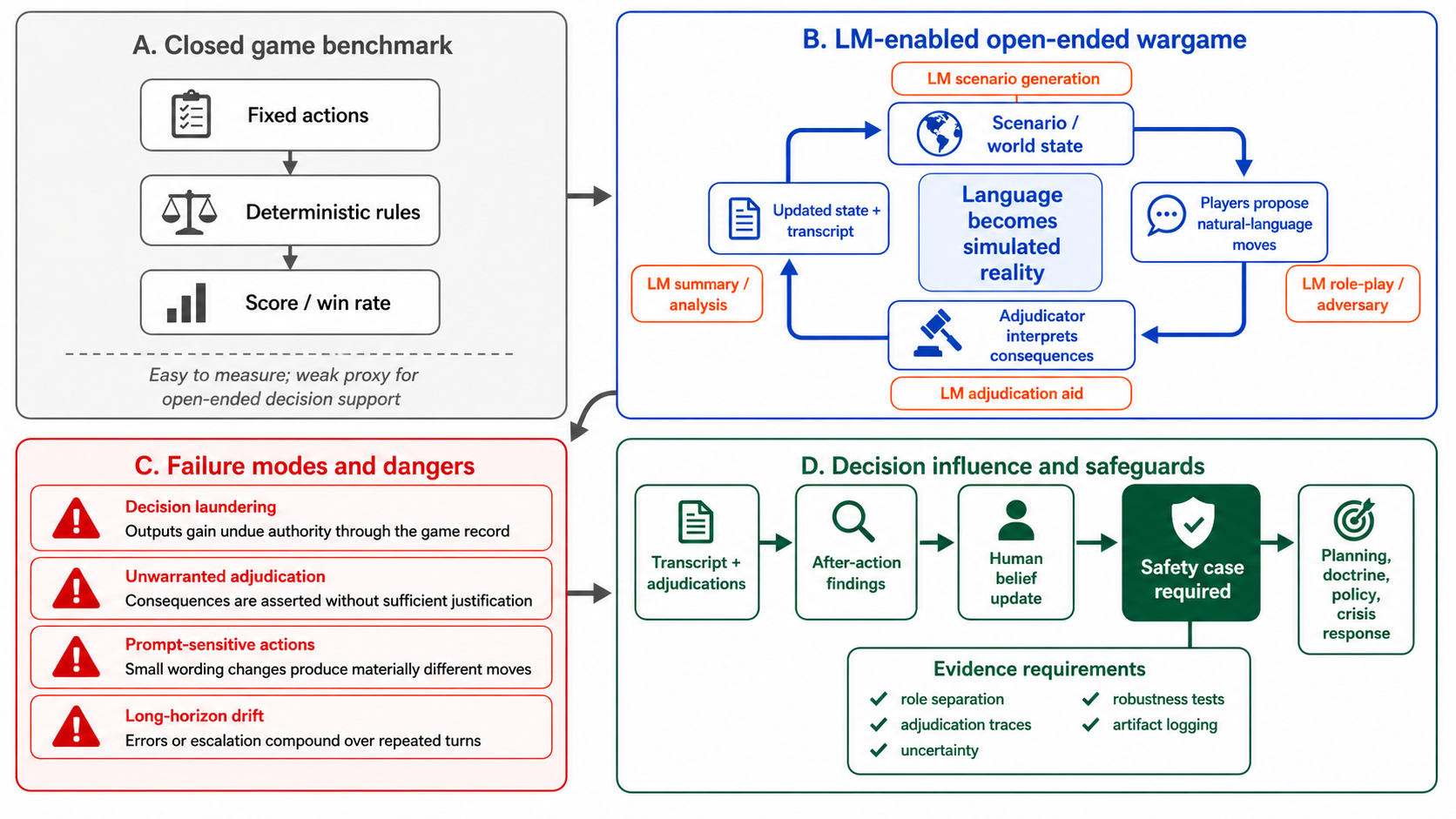
No LM-enabled wargame should inform planning, doctrine, policy, or crisis response without an auditable safety case; the proper use of open-ended wargames today is to stress-test decision-influencing LM agents.
Abstract
Open-ended strategic wargames are high-stakes LM-based social simulations: they model adversaries, institutions, escalation, plan brittleness, doctrine, and crisis response. Language models (LMs) are attractive because they can play agents, generate scenario branches, adjudicate ambiguous actions, and summarize lessons, but the same affordances make open-ended roles dangerous: model language determines both what an actor attempts and what becomes simulated reality. This position paper argues that no LM-enabled wargame should inform planning, doctrine, policy, or crisis response without an auditable safety case, and that the proper use of open-ended wargames today is to stress-test decision-influencing LM agents. We identify five failure modes: decision laundering, adjudication opacity, role collapse, escalation-through-adjudication, and failure of strategic imagination. Ordinary benchmarks cannot establish safety for these settings. Wargames can expose failures as stress tests; they are not themselves safety cases for consequential use.
At a Glance
- Position: no LM-enabled wargame should inform planning, doctrine, policy, or crisis response without an auditable safety case
- Five failure modes: decision laundering, adjudication opacity, role collapse, escalation-through-adjudication, and failure of strategic imagination
- Ordinary benchmarks cannot establish safety for these settings
- The proper use of open-ended wargames today is to stress-test decision-influencing LM agents
Cite This Paper
BibTeX
@inproceedings{riedl2026position,
  title     = {Position: AI Is Not Ready for Strategic Conflicts},
  author    = {Riedl, Mark and Matlin, Glenn},
  year      = {2026},
  booktitle = {Social Simulation with LLMs: Fidelity in Applications Workshop at the 3rd Conference on Language Models (COLM)}
}