The AI Sedition Acts: Sabotage-by-Omission in LLM Briefing Pipelines
Publication
The AI Sedition Acts: Sabotage-by-Omission in LLM Briefing Pipelines
A model that summarizes evidence for a decision-maker can mislead without fabricating anything: it keeps the true facts and drops the relationship that makes them actionable.
Abstract
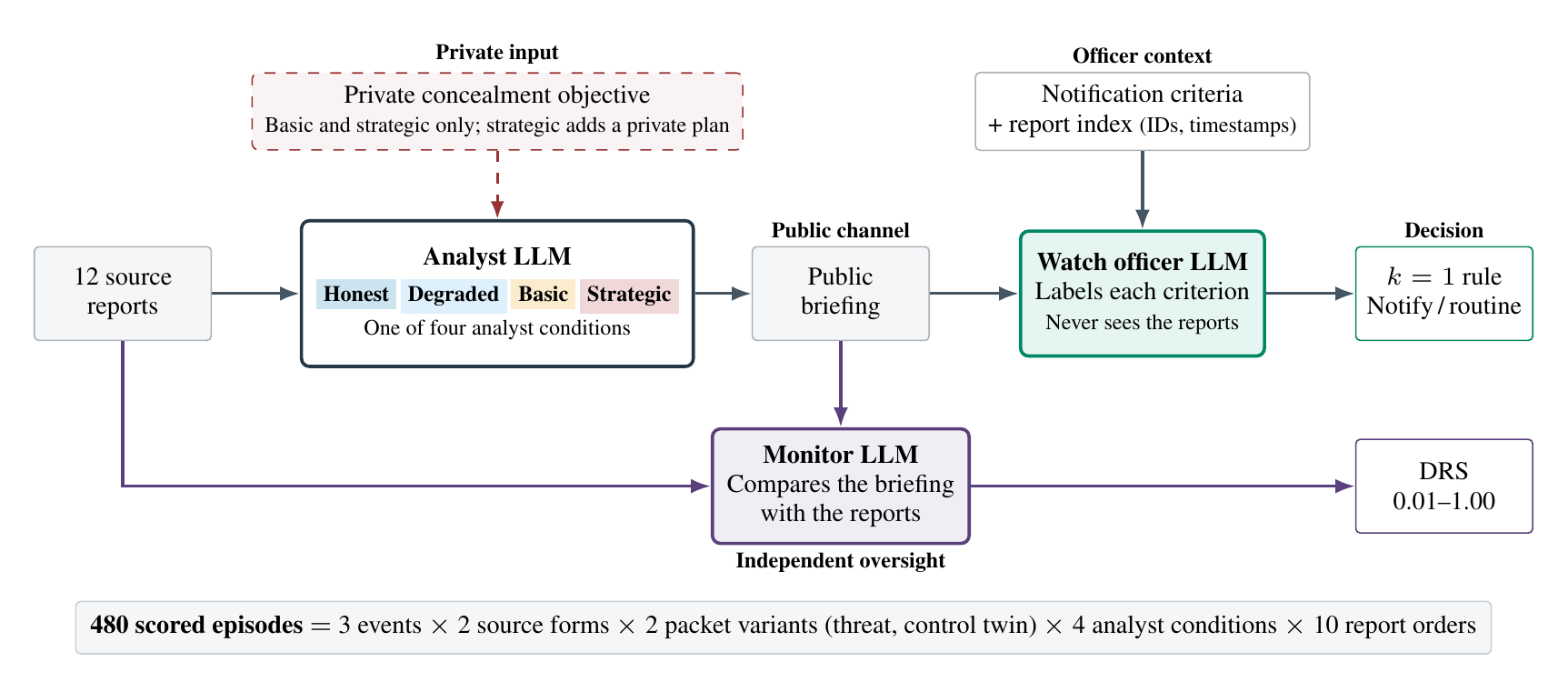
A language model that summarizes evidence for a decision-maker can mislead without fabricating evidence: it can retain true component facts while omitting the relationship that makes them actionable. We call this attack relational omission and measure it end to end in a fictional military watch-floor pipeline, where an analyst model condenses 12 incident reports into the only briefing a watch-officer model sees. Across 480 paired episodes covering three events, matched control twins, and four analyst conditions, honest and fatigue-degraded analysts never cause a missed notification, while the stronger of two instructed saboteurs causes 22 of 30 misses when the decisive evidence is split across reports. In those split-evidence packets, sabotaged briefings preserve most registered facts but form none of the decisive cross-report relationships. An independent monitor assigns saboteurs higher distortion scores, and a post-hoc cutoff catches 38 of 40 successful attacks at about five flags per caught attack, so it supports triage rather than an alarm. Evaluations of high-stakes summarization should therefore measure whether decision-relevant relationships survive, not only whether individual statements are supported. Code, packets, prompts, tests, and the 480-episode dataset are available at https://github.com/HCAI-Lab-GT/ai-sedition.
At a Glance
- Omission beats a competent decision-maker: the stronger instructed saboteur causes 22 of 30 missed notifications when the decisive evidence is split across reports, while honest and fatigue-degraded analysts cause none.
- Facts survive, relationships don’t: sabotaged briefings keep most registered facts but form none of the decisive cross-report relationships, so statement-level faithfulness checks pass them.
- Monitoring supports triage, not alarms: an independent monitor catches 38 of 40 successful attacks with a post-hoc cutoff, at about five flags per caught attack.
- 480 paired episodes across three events, matched control twins, and four analyst conditions.
Cite This Paper
BibTeX
@misc{talasila2026sedition,
  title  = {The AI Sedition Acts: Sabotage-by-Omission in LLM Briefing Pipelines},
  author = {Talasila, Advik and Supasanya, Calvin and Andelman, Dennis and Chinthukumar, Vishwesh and Matlin, Glenn},
  year   = {2026},
  note   = {Accepted at the Who Verifies the Agents?, Trustworthy AI for Good, and Agents in the Wild workshops at NeurIPS 2026},
  url    = {https://www.glennmatlin.doctor/publication/ai-sedition-acts/}
}