Every month or two, someone posts a thread about how to be good at AI research and publish at NeurIPS. These posts do crazy numbers… which is so strange, because the right advice is almost always just what everyone already knows. Focus on understanding seminal papers. Keep a log of all your ideas and work. Be bold but accept criticism. Stare at the data endlessly. You know this crap, why bother to list it all out? All of this advice is completely true and also completely useless, because nobody will do any of it.
Let’s be honest, doing all the right stuff is really hard. There is a Ronnie Coleman line I think about a lot: everybody wants to be a bodybuilder, but nobody wants to lift heavy-ass weights. Doing good research takes a lot of effort and hard work — and no one gets a viral article based on advice that’s hard to do.
So instead, I’m going to write the long-form post that this site deserves — here are the things you should do to be bad at research and get nowhere. You might already be doing some of these! I’ve used all of these techniques myself, and speak with the expertise of personal experience. Hopefully, by the end of this article, you will have learned that the best way to avoid being wrong or failing is to keep doing what does not work.
Bottom Line, Up Front: If you follow my advice, you will never have to deal with people critiquing your research papers, because you’ll never get any of them done!
Making decisions is hard, so never decide what to do.
To do bad research, you should avoid conflict at all costs. After all, you can’t get blamed for a choice you never made! The fastest way to get blamed for something is to be responsible. That is why choosing a research problem yourself should be avoided. Do you really want to risk pissing off your PhD advisor? Instead, it is a much better idea for you to just inherit your research direction from them. Maybe they have some spare funding and need you to justify why their 2007 plumbus about neurosymbolic systems does chain-of-thought auditing better than the SOTA dinglebop released from a frontier lab.
If you can’t defer picking your research vision to a graduate advisor, I suggest going off whatever crapola some big lab just announced last quarter. You’ll know it because it’s the paper being quote-tweeted into the ground this week by a bunch of people who spend their time talking about research because no one trusts them to actually do any of it.
Bonus points if you inherit your research problem from someone who is disconnected from actively publishing and works in a very crowded field. If you can inherit the right problem with ten thousand people who have an eight-month head start and more computing power, then you are guaranteed to fall behind others. Following this hot tip is genuinely one of the safest bets right now if you want to do bad research.
Finally, remember — if the research question that was dumped on you turns out to be impossible, that is not your fault. It was impossible for everyone else, too. And if you find yourself constantly being scooped or lost in the stampede of papers, that’s fine! They scooped hundreds of others, too. You can’t be singled out in a stampede — that is the whole appeal of being part of the herd after all.
Focus on what everyone else is reading so you don’t feel FOMO.
Your information diet should consist solely of the HF papers of the day, posts trending on X, or spammed to your email. This guarantees you arrive at the field’s conclusions at the precise moment the field arrives at them, which is the moment they stop being worth anything, which is ideal, because now no one can accuse you of an original mistake.
Always be sure to skim the X thread and leave a sycophantic comment, but never bother to read the paper. If you do accidentally open the paper link my advice is to only look at the charts and close the page as soon as possible. If the paper has an appendix, avoid it — that’s where the real details are. The limitations section is just the authors being humble or dealing with Reviewer 2. Skip reading it, and rush ahead.
Avoid old material at all costs. Richard Sutton did his thing before LLMs, and Shannon’s biggest contribution was his cool first name. These bozos didn’t have a cluster of H200 GPUs, so what the hell could they possibly know?
Finally, keep your interests narrow. People who waste their time studying subjects like neuroscience or philosophy are not researchmaxxing. Exploring related topics means you will start having new ideas, and that means you will end up being right or wrong — a tragic mistake.
Slow down and do it all by hand.
Recursive self-improvement is for machines, not humans! Velocity in research is measured as the speed at which you discover you are wrong, so slow the hell down! Being slow is not a weakness; it’s rigorous! Ask an AI Agent to monitor my training runs, are you crazy? Bad research means you should launch every run by hand and have the results buried in a random tmux session you will never find again. Are you trying to improve reproducibility for others? That will only kill the vibes. If your result cannot be reproduced, it adds a sense of “mystique” to things.
You should refuse to waste even a single day on tooling. Tooling is engineering, not research! Engineering is much less important than the question. Writing SLURM batch jobs is beneath the idea guy, beneath you. Reading raw data yourself is what people do when they aren’t paying for a Super Max Pro 200x account to code more. Finding benchmarking fails and sorting things is unglamorous — who are you, Florian Brand? You got into AI because it’s glamorous, and data is for the peasants. Understanding your data is likely to lead to hard work and good research, so avoid grokking it at all costs.
Perfect faking it, and catch me if you can
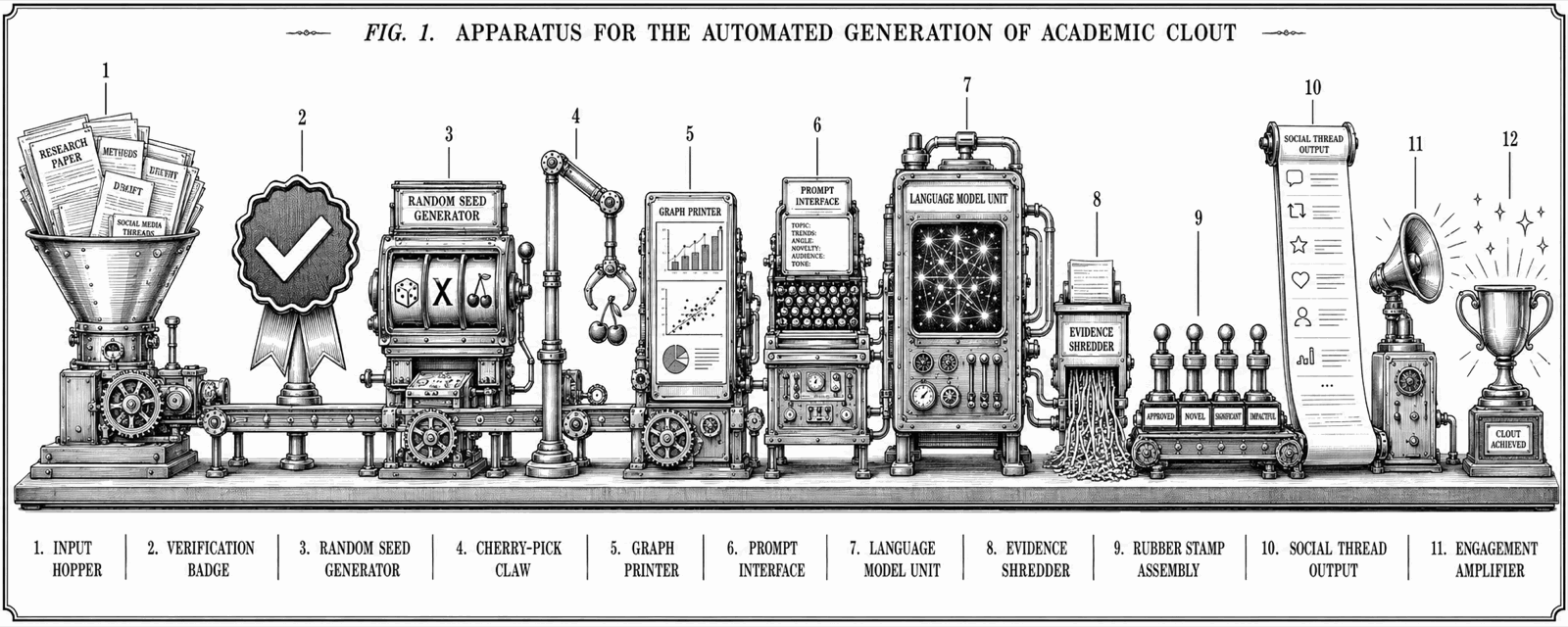
And here is the final skill there is to learn — the one finger death punch of doing bad research — your social media post is the final deliverable, papers are meant for screenshots, and no one can tell the difference between someone who did good research and someone who vibe-coded their thesis this afternoon.
Trying to earn credentials like a PhD is a huge waste of time. It will take you something approaching a decade in graduate school, which is a whole lotta time not queuing up for gatcha games. What’s an affiliation? It’s just a line of text. Results are just pretty plots, not new ideas. Adopting the persona and lying works because your audience wants to hear these things. The only way someone could ever find out is if they bothered to check. Thankfully, (mercifully), folks don’t do that. They nod, bookmark, and scroll on.
Did you get the joke yet?
If you’ve read this far, then you probably got the joke, but just in case you didn’t, here is the punchline: a vanishingly small amount of bad research comes from people being dumb. Bad research happens when you (a beautiful and deeply empathetic person who cares about doing great work) have what is genuinely a very reasonable desire to never be wrong in front of other people. Personal growth is hard, and the reality is that failure is not optional. Everything I talked about in this high-effort shitpost is just a way for you to make an early exit and avoid personal growth. What stinks about research, though, is that fighting against that feeling is pretty much your whole ass job. Science is a social process that requires people to communicate, collaborate, and even engage in conflict. Research is about finding out, in public, that someone (maybe you) was wrong, and then making sure everyone is a little less wrong next time. If you do your best to fuck around but avoid finding out, then you and the rest of society will never discover what truth was.
The TLDR for people who want to do bad research:
You should work just hard enough to look kinda like a researcher without ever having to do any real research. If your metric is maximizing social media attention, the optimal game move is to drop the personal growth part of the research and just criticize others. Putting on the AI researcher persona is very cheap, and there’s a huge online audience begging for slop.
Most of the time, faking your accomplishments and lying works because people don’t check. Unless someone has a few hours in their afternoon and decides to scratch the surface. But the best thing about this whole genre of low-effort motivational slop is that people no longer check citations.
So my advice to anyone looking to do poor-quality, low-impact research: stop working on being a better human and focus on posting more on social media.
Ad astra per aspera,
Glenn Matlin